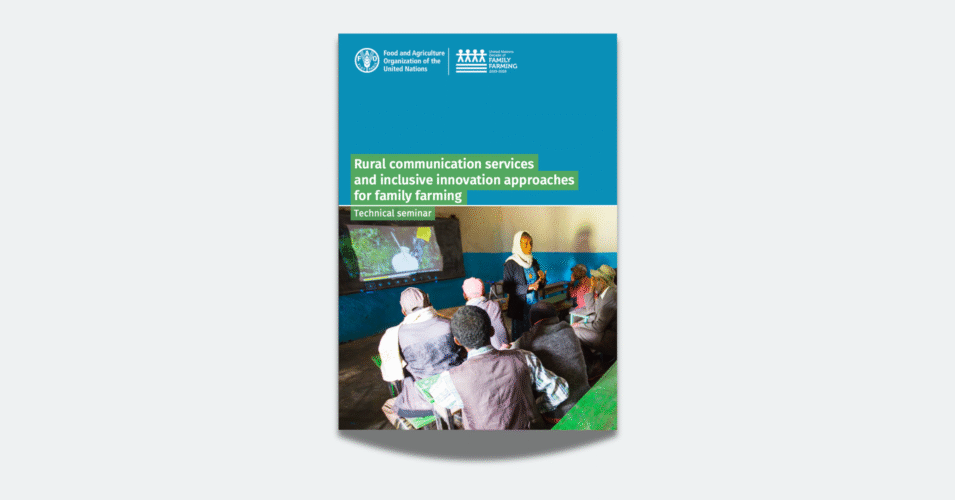
Over 100 participants from around the world convened at the headquarters of the Food and Agriculture Organization (FAO) for a seminar on “Rural Communication Services and Inclusive Innovation Approaches for Family Farming.” This global event marked the midterm milestone of the United Nations Decade of Family Farming (UNDFF) aiming to amplify the voice and impact of family farmers in transforming agrifood systems. Key insights of the seminar are summarized in a new technical report titled “Rural communication services and inclusive innovation approaches for family farming.”
Co-organized by FAO’s Communication for Development (ComDev) team, the Partnerships and UN Collaboration Division (PSU), and the Office of Innovation (OIN), the seminar spotlighted the central role of communication in empowering smallholder farmers and communities through Rural Communication Services (RCS).
RCS are participatory, inclusive platforms that allow farmers to co-develop knowledge, exchange ideas, and make informed decisions. The seminar emphasized that communication must begin with people and not technology. This includes everything from community radio, participatory video, and hotlines to social media and mobile messaging, all tailored to the needs of farmers.
For example, in the Philippines, the Department of Agriculture’s Agricultural Training Institute (DA-ATI) has rolled out over 1,500 information centers and kiosks, along with a Digital Farmers Program. This initiative trains farmers in digital skills such as mobile phone usage, internet research, and social media marketing.
Meanwhile, in Ethiopia, the 8028 Farmer Hotline offers a multi-language service providing agronomic advice through voice and text. Since its launch, the platform has received over 60 million calls from more than 3.5 million smallholder farmers, showing the strong demand for accessible agricultural information.
ComDev Asia, YenKasa Africa, and Onda Rural in Latin America are the three regional FAO-supported initiatives at the heart of advancing RCS. These networks bring together farmer organizations, community media, and academic institutions to promote participatory communication. In Asia, ComDev Asia supports online platforms, participatory video training, and collaborative research. While YenKasa has facilitated radio programs, capacity building, and digital campaigns in local languages for Africa.
The initiatives share a common goal to ensure that communication is utilized inclusively in local development. Studies and consultations presented during the seminar confirmed the effectiveness of these approaches. They found that when farmers are directly involved in communication planning and delivery, there is an increase in confidence, entrepreneurship, ICT skills, and better farming practices.
Beyond improving access to information, RCS enables structural change by supporting inclusive innovation. This was demonstrated in the seminar’s second part, which introduced the Living Labs model. In countries like Indonesia and the Netherlands, these innovations bring together farmers, scientists, and local stakeholders to co-create solutions for agriculture. Living Labs apply open innovation and participatory methods, ensuring that technologies respond to actual needs.
Other programs, like Farmer Field Schools (FFS), are using digital tools to expand reach and enhance learning. FAO’s new “E-empowerment” project integrates mobile apps and digital readiness assessments into FFS in Syria and Mozambique, helping address barriers related to gender, age, and disability.
Participants concluded that scaling up RCS will require strong policy support, sustainable funding, and cross-sectoral partnerships. Priorities include integrating RCS into National Action Plans, strengthening local capacities, and collaboration among farmer organizations, government agencies, and academic institutions.
As the UNDFF moves into its final phase, the momentum from the seminar reflects a shared global commitment to ensuring that no farmer is left behind. With communication as a tool, inclusive innovation is no longer just a vision but a growing reality in fields around the world.
Article contributed by Maria Soledad, CCComDev intern.
Comments are closed, but trackbacks and pingbacks are open.