
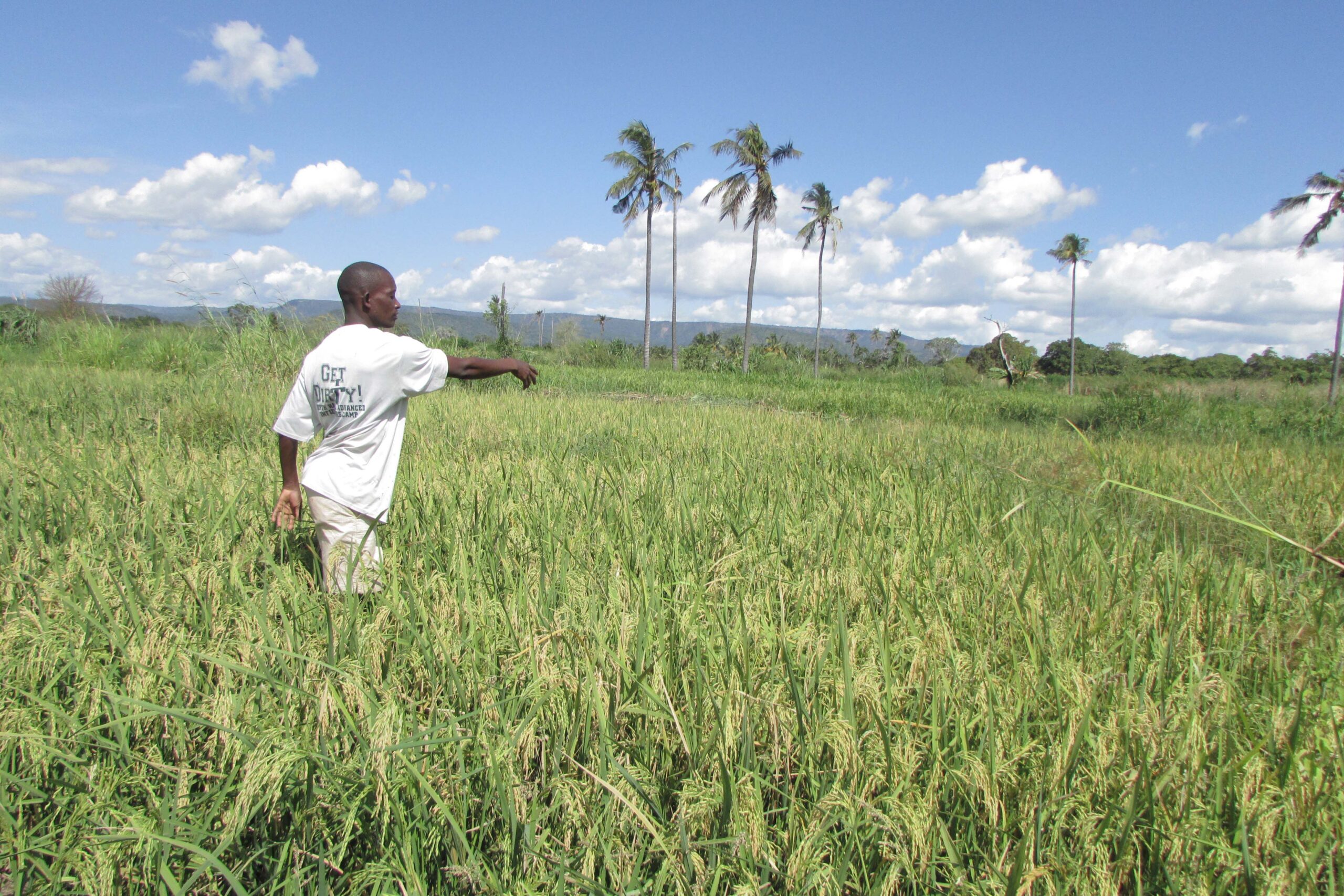
The challenges that come with constant unpredictable rainfall, soil erosion, and decreasing productivity have become a main source of concern for small-scale farmers in Tanzania’s Lushoto District. Growing uncertainties brought by climate change to these communities who rely on rain-fed agriculture calls for solutions that would ensure they are well-equipped to adapt to its impacts. To achieve this, one innovative approach is showing that the best way to prepare for the future might be to witness it firsthand.
A team of researchers at the CGIAR Research Program on Climate Change, Agriculture and Food Security (CCAFS) introduced a method known as the Farms of the Future (FotF) approach. This approach uses a climate-analogue tool to match regions with climates that resemble another area’s projected future. Its purpose is to take farmers from one region and let them learn directly from their peers who are already living in the conditions that they themselves may soon face.
Five local stakeholders and 15 farmers from Lushoto participated in a 10-day learning journey to southern Tanzania. There, they visited communities whose climates reflect what Lushoto may experience in the coming decades due to climate change. During their journey, they were introduced to various climate-smart agriculture (CSA) technologies such as drought-resistant crops, biogas systems, and community-run weather stations.

This map shows the areas that the farmers visited during their 10-day learning journey. Photo courtesy of MDPI.
For this initiative, the emphasis is on farmer-to-farmer learning. Using flip cameras, participants documented their experiences to later share with their communities. When they returned, they shared lessons through informal meetings, village gatherings, and even church announcements. Many of them reported adopting techniques such as improved crop varieties, intercropping, early planting, and the use of scientific weather forecasts. However, they combined their own indigenous knowledge with these techniques for better planning and risk management.
The study also explored gender dynamics, it revealed that women favored techniques like intercropping and using fertilizers, while men were more likely to adopt minimal tillage along with cut-and-carry feeding systems. However, there is still a need for further support and training as adoption of practices like Savings and Credit Cooperatives (SACCOs) and biogas remained low due to high costs and lack of technical knowledge.
Communication was a major factor to the program’s success. Over 98% of farmers received information orally from extension workers, family, or local groups. The researchers used cobweb diagrams during focus group discussions to map out the most trusted sources of information. Radio, village leaders, and religious groups ranked high, while mobile phones and TV were favored by the youth.
Through social learning, local innovation, and accessible communication, farmers can develop the resilience they need to face an uncertain climate future. But it must also be emphasized that sustained support is important to achieve long-term success. Many farmers who expressed interest in new practices said that lack of follow-up training and financial resources are their major obstacles.
The FotF approach can be a replicable model for other rural communities worldwide. Climate adaptation methods must not be limited to initiatives that dictate solutions, it is important to create learning environments that empower communities and enable them to to take control of their own resilience journey.
To read more about his study, go to this link.
For more stories like this, visit cccomdev.org
Source:
Nyasimi, M., Kimeli, P., Sayula, G., Radeny, M., Kinyangi, J., & Mungai, C. (2017). Adoption and Dissemination Pathways for Climate-Smart Agriculture Technologies and Practices for Climate-Resilient Livelihoods in Lushoto, Northeast Tanzania. Climate, 5(3), 63. https://doi.org/10.3390/cli5030063.
Article contributed by Maria Soledad, CCComDev intern.
Comments are closed, but trackbacks and pingbacks are open.