
Due to heavy reliance on traditional methods and limited access to weather information or extension services, smallholder livestock farmers in South Africa are some of the most susceptible to the impacts of climate change. In the Municipality of Raymond Mhlaba in the Eastern Cape, rising temperatures, prolonged droughts, and erratic rainfall have made raising animals increasingly difficult.
To help address this challenge, researchers from the University of Fort Hare and the University of Free State investigated whether Farmer Field Schools (FFS) could improve farmers’ understanding of climate change and strengthen their ability to adapt. Their findings offer insights into how experiential learning can empower rural communities and build climate resilience from the ground up.
Farmer Field Schools do not function like regular classrooms. They are community-based, hands-on learning hubs where farmers can gather regularly during the farming season. Guided by trained facilitators, they discuss, experiment, and observe climate-related farming issues and solutions together.
Developed by the Food and Agriculture Organization (FAO), FFS methods are designed to empower farmers through experiential learning. In the case of Raymond Mhlaba, 80 livestock farmers were surveyed over three different time points. This was before any intervention, after the first round of FFS, and after a second round. Each session included discussions and demonstrations on how climate change affects livestock, how to recognize environmental shifts, and what practices can help mitigate their impacts.
Before the FFS interventions, only 34% of farmers surveyed knew about the term “climate change.” But after one cycle of Farmer Field Schools, that number jumped to 100%. Farmers also showed significant gains in understanding how climate change manifests as they began to link extreme drought, increased livestock diseases, and rising mortality rates directly to shifting climate patterns.
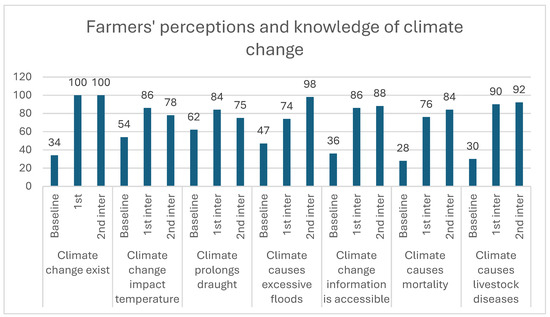
A chart showing the knowledge and perceptions of climate change by smallholder farmers who attended the FFFs in the Raymond Local Municipality study area. Photo courtesy of MDPI.
For example, recognition of drought as a climate impact rose from 62% to 84%, and awareness of flood risks surged from 47% to 98%. Access to climate-related information also improved from just 36% of respondents before FFS to nearly 90% after. Statistical tests also confirmed significant improvements in farmers’ climate change perception scores after their participation.
As farmers shared their experiences and learned from one another, their confidence grew. The study found that the FFS approach enhanced several forms of “capital.” These are human capital formed through new knowledge and confidence, social capital by strengthening community bonds, and financial capital by helping farmers understand how to protect their income sources.
These experiences are especially valuable for women and less formally educated farmers. Many participants in Raymond Mhlaba had limited schooling, yet they demonstrated an understanding of climate-related concepts when they were taught in context and in their local language.
While the benefits of FFS can be observed, the researchers acknowledge that it can also be challenging to implement. These schools require time, commitment, and skilled facilitators. They also need funding to be sustained and scaled. Moreover, although the first intervention produced significant change, the second intervention didn’t show much additional impact. This suggests that a single, well-designed FFS cycle may be enough to create meaningful shifts in perception.
Despite these limitations, the study concludes that FFS are a powerful tool for climate adaptation in rural areas. As climate change continues to threaten food security and livelihoods, especially for vulnerable farming communities, low-cost and inclusive education models like FFS could be key to building long-term resilience. Further research can be conducted on how to make climate change training a routine part of rural agricultural development through a more sustainable, cost-effective, and less time-consuming way of implementing FFS.
Source:
Mdiya, L., Aliber, M., Mdoda, L., Van Niekerk, J., Swanepoel, J., & Ngarava, S. (2024). Empowering Resilience: The Impact of Farmer Field Schools on Smallholder Livestock Farmers’ Climate Change Perceptions in Raymond Local Municipality. Sustainability. Retrieved from https://doi.org/10.3390/su16208784
Article contributed by Maria Soledad, CCComDev intern.
Image from Canva.
Comments are closed, but trackbacks and pingbacks are open.